Table of Contents
- About the National Housing Subsidy Programme
- What Will You Learn: Eligibility Criteria
- Key Financial Details, Income Limits & Cost Estimates
- Minimum Requirements & Required Documents
- Closing Date & Application Timelines
- Why Housing Subsidies & Asset Protection Matter
- Frequently Asked Questions (FAQs)
- How to Apply: Step-by-Step Guide
- Related Articles
- Final Thoughts
About the Programme
Having access to secure housing is a fundamental right under the Constitution of South Africa. The Department of Human Settlements, in collaboration with provincial departments and local municipalities, delivers government-subsidised housing—commonly known as RDP (Reconstruction and Development Programme) or BNG (Breaking New Ground) homes.
This state-funded housing scheme is designed to integrate low-income households into the formal property market, providing beneficiaries with physical homeownership, title deeds, and asset security.
What Will You Learn (Eligibility)
To qualify for a fully subsidised housing allocation under the National Housing Subsidy Scheme, applicants must meet specific socio-economic criteria:
- Citizenship: Must be a South African citizen with a valid green barcoded ID book or smart ID card.
- Age & Legal Capacity: Must be over 21 years old and mentally competent to execute legal contracts.
- Family Status: Must be married, cohabiting with a financial partner, or single with legal dependents (exceptions apply to aged persons and single military veterans).
- Homeownership History: Must be a first-time property owner and a first-time government housing subsidy recipient.
Key Details: Salaries, Financial Limits & Property Estimates
| Financial Metric | Amount / Details |
| Maximum Household Income | R3,500 per month (combined gross income) |
| FLISP / First Home Finance Threshold | R3,501 – R22,000 per month (for gap market home loans) |
| Estimated RDP Construction Value | R180,000 – R250,000 (fully funded by state subsidy) |
| Monthly Rental / Bond Repayment | R0.00 (100% Subsidised) |
| Homeowner Building Insurance Cost | Variable (Protects against fire, flood, and structural loss) |
Note: If combined family earnings exceed R3,500 per month, you will not qualify for a free RDP house, but you may qualify for a FLISP mortgage subsidy.
Minimum Requirements & Required Documents
Minimum Requirements:
- Total gross household income under R3,500/month.
- Clean record on the Housing Subsidy System (HSS) with no prior property deeds.
Required Documents:
- Identity Documents: Certified copies of applicant’s and spouse’s ID cards/books.
- Dependents’ Proof: Certified copies of birth certificates or IDs of children/dependents.
- Marital Status Proof: Marriage certificate, divorce decree, or death certificate (if applicable).
- Proof of Income: Latest pay slip, bank statement, or sworn affidavit if unemployed.
Closing Date
There is no fixed closing date for RDP housing subsidy applications. Registration on the Municipal Housing Demands Database (National Housing Needs Register) remains open continuously throughout the year across all customer care centres.
Why Does It Matter? (Property Value & Financial Protection)
Receiving an RDP house transitions your family into formal homeownership. It offers real estate equity that can be passed down to future generations. However, homeownership comes with financial responsibilities:
- Title Deed Ownership: Obtaining your title deed gives you legal title over the land and structure.
- Property Insurance Protection: Protecting your home against structural damages, fires, or natural disasters through comprehensive building insurance and household content insurance is vital once you acquire ownership.
- Legal Restrictions: By law, you cannot sell an RDP house within the first 8 years of ownership. It is also illegal to rent out an RDP house. Any structural extensions or alterations within the first 8 years require formal municipal planning permission.
Frequently Asked Questions (FAQs)
1. Can I apply for a mortgage loan or home insurance on an RDP house?
You cannot bond a free RDP house initially. However, once you receive your legal title deed, you can purchase comprehensive homeowner insurance to cover structural risks and property damage.
2. Is it legal to rent out or sell my RDP house?
No. It is illegal to sell an RDP home before living in it for at least 8 years. Renting out an RDP house is strictly prohibited by government policy.
3. What happens if I earn more than R3,500 per month?
If your household earns between R3,501 and R22,000 per month, you qualify for the FLISP / First Home Finance subsidy, which helps lower your home loan costs with commercial banks.
How to Apply
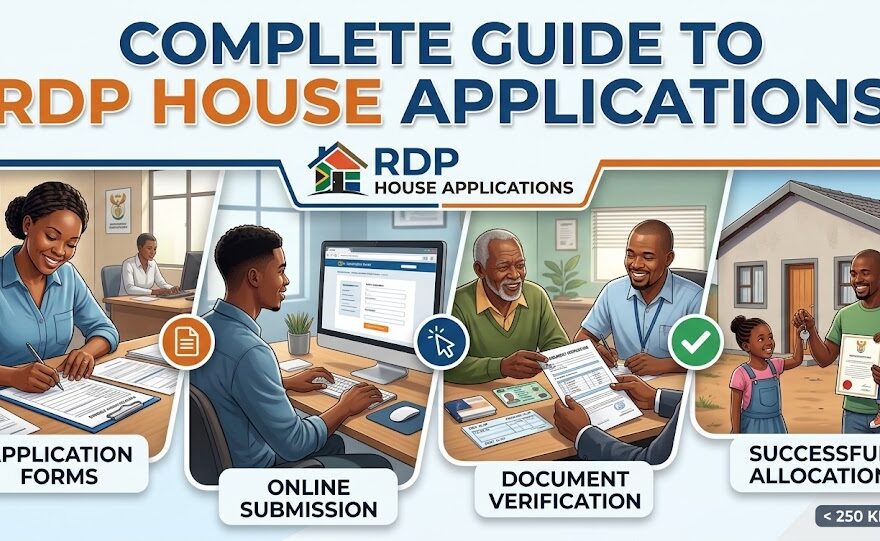
- Visit Municipal Office: Go to your nearest Municipal Housing Office or Department of Human Settlements Customer Care Centre.
- Submit Documentation: Submit certified copies of your ID, proof of income, and dependents’ certificates.
- Complete Application: Fill out the Housing Subsidy Application Form with an official officer.
- Registration: Your details will be uploaded to the National Housing Needs Register. Once a housing project is allocated and completed, you will receive your keys and title deed.
Apply Complete Guide to RDP House Applications
Related Articles
- Guide to Government Housing Subsidies and FLISP Home Loans
- How to Register on the Municipal Housing Demands Database
- Understanding Title Deeds and Property Insurance in South Africa
Final Thoughts
Securing an RDP house is a significant step toward personal financial stability and long-term asset accumulation. By understanding the qualification criteria, keeping your documentation up to date, and planning for future home insurance and property maintenance, you can protect your family’s financial future for generations to come.