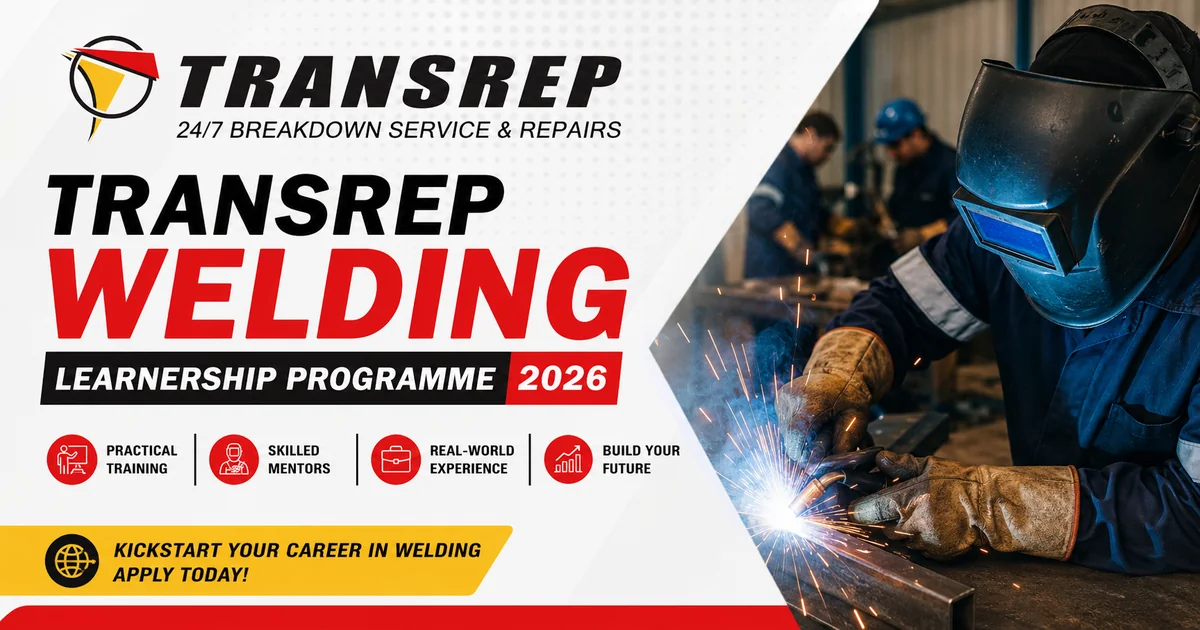
If you are a young South African looking for a practical career opportunity after Matric, the Transrep Welding Learnership Programme 2026 could be an opportunity worth considering. The programme, offered through Henred Fruehauf / Transrep, provides young candidates with practical welding and metalworking training in Bellville South, Western Cape.
The Basic/Advanced Welding Learnership is accredited by merSETA and runs for approximately 14 weeks. Learners receive practical exposure to several welding and metalworking processes, including MIG welding, Arc or Stick welding, oxy-fuel gas cutting, grinding and hand-tool skills. Practical workplace experience is also included.
Importantly for unemployed youth, the advertised opportunity has no training fee and provides a weekly stipend during the programme. Successful participants can also receive a trade skills certificate and valuable practical experience.
The opportunity is particularly relevant to young people interested in welding, engineering, manufacturing, trailer repairs, automotive repairs, fabrication and artisan careers.
Transrep Welding Learnership Programme 2026 – Quick Overview
| Vacancy Detail | Information |
|---|---|
| Programme | Basic/Advanced Welding Learnership |
| Company | Henred Fruehauf / Transrep |
| Accreditation | merSETA |
| Duration | Approximately 14 weeks |
| Location | Bellville South, Western Cape |
| Age Requirement | 18–27 years |
| Minimum Qualification | Grade 12 / Matric |
| N1/N2 | Advantageous, not compulsory |
| Training Fee | None |
| Stipend | Weekly stipend |
| Practical Experience | Yes |
| Certificate | Trade skills certificate |
| Transport | Reliable transport required |
| Application Documents | CV, ID and Matric certificate |
The vacancy information currently available confirms these core requirements and benefits.
What Is the Transrep Welding Learnership Programme?
The Transrep Welding Learnership Programme is a short, practical technical training opportunity designed to introduce qualifying candidates to important welding and metalworking skills.
Rather than focusing on only one welding technique, the programme exposes learners to multiple processes. This can be valuable because different manufacturing, fabrication, maintenance and repair environments use different welding and metalworking methods.
The course is divided into four stages, and learners are expected to successfully complete each stage before progressing to the next. The complete programme takes approximately 14 weeks.
The training is conducted in Bellville South, Western Cape, meaning applicants must be able to travel reliably to the training facility.
For a young person who has completed Grade 12 but has not yet entered an apprenticeship, internship or full-time technical job, this type of programme can provide an important first step into the skilled trades.
What Will You Learn?
One of the biggest advantages of the Transrep Welding Learnership is the range of practical skills covered.
Training includes:
- MIG welding using CO₂
- Arc welding / Stick welding
- Oxy-fuel gas cutting
- Grinding skills
- Hand-tool skills
- Practical workplace experience
These skills can form a foundation for further development in welding, fabrication, mechanical work and engineering-related careers.
MIG Welding
MIG welding is one of the practical welding processes included in the programme.
Learners can develop an understanding of equipment, welding techniques, preparation and safe working practices associated with MIG or CO₂ welding.
MIG welding is commonly used in manufacturing and fabrication environments, making exposure to the process useful for candidates who want to pursue technical employment.
Arc or Stick Welding
The programme also covers Arc Welding, commonly referred to as Stick Welding.
This provides learners with exposure to another important welding process and helps them develop hand control, concentration, accuracy and technical discipline.
Oxy-Fuel Gas Cutting
Learners will also receive exposure to oxy-fuel gas cutting.
Cutting is an important part of many fabrication and repair operations because metal often needs to be cut, shaped and prepared before components can be assembled or welded.
Grinding and Hand Tools
Welding is not simply about operating a welding machine.
A competent worker must also know how to prepare surfaces, clean metal, finish work and use hand tools correctly.
The programme therefore includes grinding and hand-tool skills, giving learners broader exposure to workshop activities.
Practical Work Experience
Another important feature is the inclusion of practical work experience.
For someone who has recently completed Matric, practical experience can be extremely valuable when competing for future entry-level positions.
Employers often look for candidates who can demonstrate more than academic qualifications. Evidence that a candidate has worked with tools, followed workshop procedures and operated in a practical environment can strengthen future applications.
The current vacancy information specifically lists practical experience as part of the programme.
Who Can Apply for the Transrep Welding Learnership?
Applicants must meet the basic eligibility requirements before applying.
The advertised criteria include:
- Be between 18 and 27 years old.
- Have a Grade 12 / Matric certificate.
- Demonstrate technical aptitude.
- Provide contactable references.
- Have reliable transport to and from Bellville South.
- Be willing to complete practical, hands-on training.
The Grade 12 requirement is specifically described as compulsory, while N1 and N2 qualifications are advantageous rather than mandatory.
Is N1 or N2 Required?
No. N1 or N2 is not compulsory according to the advertised requirements.
However, candidates who already have N1 or N2 should include these qualifications prominently on their CV because they demonstrate additional technical education.
Applicants should also mention relevant technical subjects, projects, mechanical exposure or workshop experience where applicable.
Is Previous Welding Experience Required?
Previous welding experience is not listed as an essential requirement.
However, experience in areas such as:
- Trailer repairs
- Automotive repairs
- Mechanical work
- Welding
- Fabrication
- Workshop activities
can be advantageous.
If you have gained practical experience informally, through school projects, a family business, a workshop or previous employment, explain it clearly on your CV.
Transrep Welding Learnership Stipend and Earnings Estimate
The programme advertises a weekly stipend, but the available vacancy information does not state the exact rand amount. Therefore, applicants should not assume a particular weekly or monthly figure.
The potential total stipend over the 14-week programme can be calculated once the employer confirms the weekly amount:
Total stipend = weekly stipend × 14 weeks
For example, if an employer offered R500 per week, the 14-week total would be R7,000. If the weekly amount were R750, the total would be R10,500.
These examples are illustrations only and are not the advertised Transrep stipend.
The confirmed benefit is that a weekly stipend is provided.
Because the exact amount is not disclosed in the listing, applicants should confirm the stipend directly with the employer during the recruitment process.
Benefits of the Transrep Welding Learnership
The programme offers several benefits that can be particularly valuable for unemployed young people.
No Training Fee
The advertised programme does not charge a training fee.
This can make the opportunity more accessible to candidates who cannot afford private welding courses.
Weekly Stipend
Learners receive a weekly stipend while completing the programme.
Although the exact amount is not published, the stipend can help offset some daily costs associated with attending training.
Trade Skills Certificate
Successful learners can receive a trade skills certificate.
This provides evidence that the candidate completed the programme and gained exposure to the specified technical skills.
Practical Experience
Learners gain practical workplace exposure rather than relying exclusively on theoretical instruction.
Multiple Technical Skills
The programme covers more than one welding process and also includes cutting, grinding and hand tools.
Employee Benefits: What Should Applicants Expect?
Applicants should distinguish between learnership benefits and the employee benefits normally associated with permanent employment.
The advertised benefits include:
- Weekly stipend
- Trade skills certificate
- No training fee
- Practical experience
The vacancy information does not confirm additional permanent-employee benefits such as:
- Medical aid
- Pension or provident fund
- Life insurance
- Disability cover
- Paid annual leave
- Employee wellness programmes
- Performance bonuses
Therefore, applicants should not assume that these benefits are included in the learnership.
If a learner is later employed permanently, the benefits attached to that future position would depend on the employment contract.
Career Growth Opportunities After Welding Training
A welding learnership should not necessarily be viewed as the final destination of your career.
Instead, it can be used as a foundation for further technical development.
After gaining experience, a candidate may explore opportunities such as:
- Welder
- Fabricator
- Welding assistant
- Boilermaker pathway
- Mechanical artisan pathway
- Maintenance technician
- Welding inspector
- Production technician
- Workshop technician
- Manufacturing technician
- Engineering production roles
Candidates can also investigate formal apprenticeship opportunities and further technical qualifications.
Over time, experienced artisans can progress into supervisory, inspection, production, maintenance or workshop-management positions.
Transferable Skills You Can Develop
Welding training can develop several skills that employers value beyond the welding industry.
These include:
Technical Ability
Learners develop practical knowledge of tools, equipment, materials and workshop processes.
Attention to Detail
Welding and fabrication require accuracy. Small mistakes can affect the strength, quality or appearance of finished work.
Workplace Safety
Working around welding equipment, cutting equipment, grinders and metal materials requires strong safety awareness.
Problem-Solving
Technical workers frequently need to identify problems and determine practical solutions.
Teamwork
Industrial environments often involve working alongside welders, artisans, supervisors, technicians and other production employees.
Time Management
Learners must complete practical tasks while following workplace procedures and deadlines.
These transferable skills can support future opportunities in manufacturing, engineering, logistics, maintenance, construction and technical operations.
Industry Outlook for Welding Careers in South Africa
Welding remains closely connected to several important sectors of the South African economy.
These include:
- Manufacturing
- Engineering
- Construction
- Automotive
- Transport equipment
- Trailer manufacturing
- Mining equipment
- Maintenance
- Fabrication
- Infrastructure
This means welding skills can potentially be useful in different regions and industries.
South Africa’s broader technical skills pipeline also creates opportunities for people who are prepared to continue learning after an initial training programme.
For ambitious candidates, the most valuable approach is therefore not simply to complete the 14-week course, but to use it as a foundation for further artisan training, professional certifications, apprenticeships and technical education.
Professional Development After the Learnership
Learners who want to build a long-term career should consider continuing their education.
Possible routes include:
N Courses
N1, N2, N3 and higher technical studies can help candidates strengthen their theoretical foundation.
TVET Colleges
South African TVET Colleges can provide technical and vocational training in areas related to engineering and artisan development.
Potential areas of interest include:
- Mechanical engineering
- Engineering studies
- Fitting and machining
- Fabrication
- Automotive repair
- Electrical studies
Apprenticeships
After gaining introductory welding experience, candidates can look for apprenticeships that offer more extensive workplace training.
Welding Certifications
Depending on the career direction, candidates can investigate additional welding qualifications and industry-recognised certifications.
Safety Training
Health and safety training can also be valuable in industrial environments.
Why Technical Careers Can Be a Smart Choice
Many young South Africans focus heavily on office-based careers such as banking, accounting, human resources or business administration.
Those careers can certainly offer excellent opportunities, but they are not the only pathways to a sustainable career.
Technical careers can provide opportunities for people who enjoy practical work, machinery, tools and problem-solving.
A welding career can also eventually connect with engineering, manufacturing, maintenance and production management.
For someone who prefers hands-on work rather than sitting behind a computer throughout the day, a technical career may be a much better fit.
How to Prepare a Strong Application
Before applying, make sure your CV clearly demonstrates why you are suitable for practical technical training.
Your CV should include:
- Full name
- Contact details
- Location
- Grade 12 qualification
- N1/N2 qualifications if applicable
- Technical subjects
- Previous work experience
- Mechanical or welding exposure
- Trailer or automotive repair experience
- Practical projects
- Contactable references
- Relevant skills
Keep the CV professional and easy to read.
Do not submit a CV containing unnecessary personal information.
Documents Required
Applicants are instructed to prepare:
- CV
- Copy of ID
- Matric certificate
The current listing also confirms that these documents are required for the application.
Make sure all documents are clear and readable before submitting them.
How to Apply for the Transrep Welding Learnership Programme 2026
The current online listing directs applicants to an application portal hosted through Wamly.
Apply online: Transrep / Henred Fruehauf Welding Learnership Application
The vacancy information supplied for this article also gives applications@ctn.henred.co.za as an application email address. Because application instructions can change between listings and intakes, applicants should verify the currently accepted method before submitting documents.
Important Application Advice
Before submitting your application:
- Confirm that you are aged 18–27.
- Make sure you have Grade 12.
- Prepare a professional CV.
- Include N1/N2 if you have it.
- Mention relevant technical experience.
- Include contactable references.
- Make sure your ID and Matric certificate are clear.
- Confirm that you can travel to Bellville South.
- Do not pay anyone claiming they can guarantee selection.
- Apply through the advertised recruitment channel.
Final Thoughts
The Transrep Welding Learnership Programme 2026 provides an opportunity for eligible young South Africans to gain practical technical skills without paying a training fee.
The 14-week programme covers several useful welding and workshop processes, including MIG welding, Arc welding, oxy-fuel gas cutting, grinding and hand tools. Learners also receive practical workplace experience and a weekly stipend.